레이블이 hydraulic rock splitter인 게시물을 표시합니다. 모든 게시물 표시

2017년 6월 23일 금요일

How to make order details for a new Rock Splitter?

Which size Splitters Fit my Job Site?


It is not easy to fix the set for a new businessman though the amount of splitter is not so great.
Following things should be considered :

1. Rock volume to remove.
2. Time frame for the removal project.
3. Required equipments beside the splitters set.
4. Required manpower by quality or experiences.
5. Total available finance.


Once you have above figures in details, still you need to know how much volume of work you can proceed every day or every week . 

 D&S tech regards the drilling capacity the most important factor.

With a hand-held splitters set:

As known before, hydraulic splitting follows after the holes are ready. The spacing is a decisive factor in work rate ( or speed).  This spacing is a mix of three factors: splitter force,  rock's strength, and drill rig's capacity.
When the spacing is made too near  from optimal distance, total number of holes are too many and time-taking delay occurs. On the contrary to this, if the spacing is too far from optimal, the splitter may take too long time to split.  So the spacing has to be decided by an experienced drill rig operator who knows drill capacity as well as rocks quality and splitter's quality.

We suggest a spacing of 500mm in the beginning as a rule of thumb. This spacing should be modified carefully after some experiences to less or longer distance.  There are very hard stone like quartz which are hard to drill a few inches per minute. With this kind of ultra hard rocks, you have to adjust the hole distance
to 20~30cm .  There are also soft rocks .If you can drill holes of 1200mm within 20~30 seconds, you may make spacing distance of 1,000mm from the beginning.  It is difficult to generalize of standardize this spacing matter in a simple figure. Instead, you have to touch and experience with your body.

We recommend one of followings:

1. When your work load is small or  once for all with enough time frame, 
   we recommend the  small diameter splitters of 80mm or 85mm. 
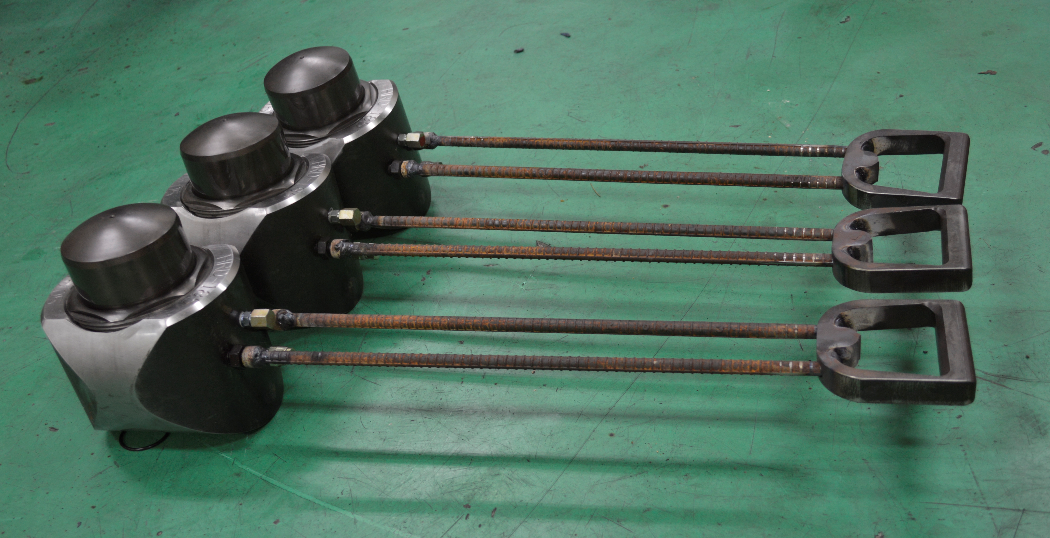
    These splitters have 10,11,12 pistons on each cylinder. Total length of splitter is upto 800mm.
   HRD-tech.com keep 10pistons splitters in stock usually for prompt delivery.
  The drill rig makes holes of 89mm or 95mm . Small size holes take less time than large ones.

2. When your work load is large and repeated continuously for more than a year job,
   we recommend the large diameter splitters of 95mm ( or 90mm) 
  Drill holes are 105mm or 100mm . The drill rig is usually larger ones too than small hole drill rigs.
   With this size, hand-held splitters are shorter than smaller ones because of weight limit.
  Usual splitter's length is between 600mm to 700mm.
  
 Large diameter pistons produce stronger forces than smaller diameter pistons. Eventually, the large diameter splitters are good for fracturing the hard rocks too.

3.  When you work with very very hard rock, we recommend to use larger size splitters of one or two pistons      
       ( 135mm dia splitters with 2 pistons)                 ( 182mm diameter splitter with one pistons )
 For example, 135mm diameter splitter is built with two pistons in a cylinder.  182mm diameter spliter has one piston in a cylinder. For a manual handling, the weight needs to be limited under 40kgs.
 This large diameter splitter is good for fracturing the hard rock with large spacing of more than 1000mm.
Hand-held 95mm dia splitters in holes of 105mm
 
   With spacing of 600mm between hard rocks, the 95mm splitters of 700mm long  work fine in granite sites.
Vertically drilled holes of 105mm  are spaced 600mm between holes.


With machine-held Splitters;


Machine -mounted or machine held splitters are specially designed and offered.  Some of them are shown as below;

 1. Excavator-mounted splitters of 150mm diameter with 8 pistons

  
 2. Other sizes : 
    100mm splitters of 800mm long with 10 pistons.
    135mm splitters of 900mm long with 7 pistons.

    As drill rigs are limited in maximum hole sizes, either  115mm holes or 127mm holes are recommended.
   The length of splitters is not limited in weight nor depth.  It is recommended to fit the fastest rate of drill rig  in deciding the length of the splitters.
  Special grip system togetherwith coupler device is provided according to request. We also accept your suggestion in building the splitter structure.

  We are using our expertise in building cylinder and pistons which will last for the most durable time.


A representative  splitter  85mm diameter 11pistons, 780mm long.


2017년 1월 30일 월요일

Hydraulic Piston Rock Splitting-Intros


  Hydraulic Rock Splitting

---   A New Method for Breaking Rock without Vibration. —


How tool works

A piston rock splitter machine is composed of a power pack and one or more number of splitting cylinders connected with hoses.  Each power pack is driven by electric motor supplied by  380(400)VAC 3 phase or 220(240)VAC single phase power source. Splitting cylinders are  connected to the powerpack through  hoses of low pressured and high pressured .Splitting cylinders are  sized to fit the pre-drilled holes of 90mm diameter or larger ( 95,100,105 mm diameter holes)


The splitting cylinders are inserted into the pre-drilled holes. Then the pistons expand as the hydraulic pressure force is activated. When the expanded pistons crack the rock ,the rock is fractured  to be crushed.


  Pic-1 

  Pic-2

 Pic-3


  Pic-4
 Pic-5
 pic-6

 As we see on above pic 1~6, pistons are rising or falling by hydraulic pressures. When high pressure is activated, the pistons rise while low pressure is activated, pistons fall down. The cylinders in the drilled holes  are smaller than the drilled holes by 10~15mm  in diameter. When the holes are drilled  90mm diameter, the piston cylinders have 80mm diameters. Usual stroke of each piston has 25~35mm depending on the cylinder rod diameter.


Drilling is done by a separate rock drill . Crushing  ( or mucking) the rock is done by a breaker or  an excavator.
 Then crushed rocks are removed from the site.

  The holes are made vertically  or horizontally with some angles or straight. Usually horizontal drilling is made for large volume work. Vertical drilling is made in an inevitable case  such as shaft digging, trench work or quarrying sites.


Hydraulic Power Pack

Hrd-tech has been offering  a  very sturdy and reliable power pack among  its kind. The hydraulic power pack is driven by electricity of AC power ( either 380V3phase or 220V single phase,50/60HZ). A power pack supplies the hydraulics to the pistons of cylinders. This power pack must be a proven one. Its failure means non-operation of the machine.  The power pack should  be from the renowned supplier, because it is not like the ordinary power pack used for lifting jakki .

Hrd-tech.com has been manufacturing custom made power packs since late 1990’s. The power pack has been improved and improved  for  its reliability.  It is producing hydraulic power upto 2,500kgf/cm2. But it s  use  is l recommended to limit  of  1,200kgf/cm2  pressure for the safety sake.. AC mains power supply required  is  either 220~240V AC or 380 VAC  3phase. with frequency of 50/60HZ.


The power pack is accommodated inside the case. A power cord is connected to the power pack socket. When the green push button is  pushed , the electricity is on. Then the motor begins to run. As the motor runs, hydraulics is loaded.
When the lever is directed to left, the high pressure is loaded. When the  lever is turned to right, low pressure is loaded.
The medium position of the lever means the hydraulics is NOT  loaded. Hydraulic oil is returned to the tank without producing any pressure.

Each  cylinder  in the hole produces expanding pressure of  150MT or more. When multiple cylinders are activated, very high pressing power is produced  .

Each cycling of high to low pressing fluid takes time of 2~3 monutes.
It is a safe machine.  It needs very little maintenance  of only with  regular cleaning outside.  Oil and filters are recommended to replace  every 6 months.


               (  Hydraulic pressure cracks the holes of the rock,)


Splitting Cylinders with Pistons--- Splitters
In the early stage of rock demolition, wedge type splitting tools were used. As a German company DARDA named it as Darda, it has been known as Darda splitter. Darda has been very effective for concrete works. Some people used Darda for rock demolition but it took quite a long time   because the spacing for rock hole was so near, lots of small holes had to be made.

Piston Cylinders began to be  used  in late 1990 mostly in Korea.  Korean government restricted to use any explosives for rock removal in residential area or building site.
 Usually the holes are drilled  with spacing of between 30cm to 60cm . In special hard rock the space is made more closely like 30cm .  Soft rocks need  more distant like 60cm spacing between holes. In the beginning, holes were made  in 95mm or 105mm . The  cylinders are made in 85mm or 95mm diameter steel rods.  The length of the steel rod has to be limited in its length or weight. THose cylinders were mostly handled by human hands. The weight was set between 30~40 kgs.  
( see below size table).


Division
unit
                           Manual   type
   Mechanical Type
SR80-10
SR85-10
SR85-11
SR95-06
SR150-2
SR185-1
SR95-10
SR150-08
Cylinder  Diameter
mm
   80
  85
  85
   95
  150
  185
   95
   150
Length of Cylinder
Excluding. handle
mm
  650
 745
 810
  525
  300
  195
  705
  1000
Weight of Cylinder
Including. handle
 kg
  27
 30.8
 32.5
  29
   36
  35
   39.3
   125
Number of Pistons
 #
  10
 10
 11
   6
    2
   1
   10
     8
Diameter of
Pistons
D1
mm
  38
 40
 40
  45
   58
   90
   45
    58


Force
piston
ton
  18.2
 20.8
 20.8
 28.5
  58.8
  114
  28.5
    58.8
cylinder
ton
  182
 208
 229
 171
  117.6
  114
  285
    470
Required
Hole diameter

mm

 90

 95

 95

 105

 165

 200

  105

   165
Applying force
Kgf/cm2
1,200
1,200
1,200
1,200
1,200
 1,200
 1,200
  1,200


Splitting cylinders are made with special steel. The steel needs special machining unlike normal machine. The structure must  stand with  the ultra hard impact during its repeated stressing activity.  It needs special heat treatment  to get temper and tensile flexibility.It should be light and sturdy enough for mannuvoering and protecting its function under high pressure.
Manual type is used with workers’ hands. Manual type weighs around 30kgs including its handle.Mechanical type is assisted by a winch or an excavator with some grippers.


Most popular cylinders are SR85-10 or SR85-10 for medium hard rock splitting. They are  rather light but producing very heavy  cracking power.

SR95-06 or SR95-07( not listed) is used for  very hard rock splitting. Tunnel job requires SR95 types because of hard rock .

From above table, you can see that SR185-1 produces the strongest force among all other sizes. Though the total cylinder force is not big,SR185 has the most powerful cracking force.

Mechanical type is used by limited contractors who need more productive constant work. There is no limit in weight or length.   Sizes are built by customer specifications.

Pre-requisite: Rock drilling work.
 Every hydraulic rock splitting, whether it is wedge type or piston type, preparation of rock hole is required. From our experience, rock drilling takes 2~3 times of splitting time. So every rock demolition specialist must study the rock drill job carefully.
here follows several hints for a new entrepreneur.


Drilling Holes for Splitting
Rock drilling has been done with many rock drills. Some of the following methods have been used for hydraulic piston rock splitting.
Crawler rock drill

A crawler rock drill has been used for drilling holes in the rock. It is speedy in deep drilling upto 3 meter deep. The rod is extendable.
Drills are built for certain range of drill bit sizes. The drill bit of 90~105mm is to be used for the manual cylinders.


Core drill mounted on excavator.
Very hard rocks are drilled with core drills. Usually large size holes of over 120mm are made by core drills.


Following photo shows core drilling work. The core drill is mounted on an excavator.
The cylinder diameter is smaller than the drill size by 15mm .In case of 200mm drill hole, 185mm cylinder is used. For the 165mm diameter holes, 150mm cylinder is used. As the drilling takes lots of time, one or two cylinder is enough for splitting job

 Drilling pace decides the rock splitting.

Drilling pace is determined by several factors:

1. Spacing between holes:  

2. Depth of the holes:

3. Splitter's expanding power.

4. Rock's characteristics.

For a guide purpose, we recommend to set a spacing of 50cm with manual splitter.
For the mechanical splitter, 60cm spacing is recommended.  Then based on your experience of some splittings, you can adjust the spacing  wider or narrower.